Five Destinations: How design, technology and changing lifestyles are redefining modern yachting that define Luxury Yachting beyond the ordinary
The evolution of yacht design is becoming increasingly subtle.Rather than being defined solely by length, volume or visual spectacle, the new generation of yachts is being shaped by a different set of priorities: connection to the sea, wellbeing, efficiency, adaptability and intelligent technology.Recent projects from some of the world’s leading shipyards suggest that luxury at sea is moving away from excess and toward a more considered experience—one in which engineering and design work almost invisibly around the people on board. Here are five details increasingly influencing the yachts of tomorrow.
1. A Closer Connection to the Water
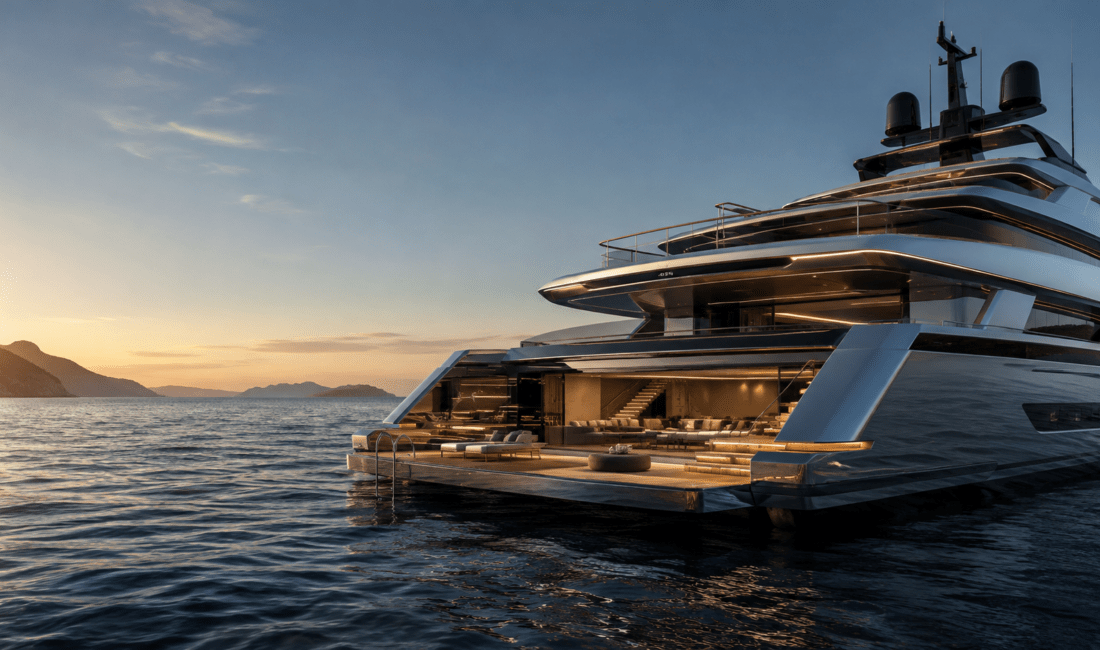
Perhaps the most visible transformation is taking place at the stern. What was traditionally a functional area dedicated to tender storage and technical operations has evolved into one of the most important lifestyle spaces on board.Contemporary beach clubs now incorporate terraces, swimming pools, lounges, bars and direct access to the sea. Burgess (2026) highlights this broader shift toward expansive sea-level spaces and indoor-outdoor living, reflecting a growing preference for yachts that create a stronger relationship between guests and their surroundings.
Recent designs take the concept even further. Feadship’s Project 826 features a 165-square-metre, two-level beach club opening directly onto the water through large fold-out terraces, while natural light enters through the glass-bottom swimming pool above (Feadship, 2026).The result is an important change in perspective: the yacht is no longer simply designed to travel across the sea. Increasingly, it is designed around experiencing it.
2. Wellness as Part of the Architecture
Wellness facilities were once regarded as additional amenities. Today, they are increasingly influencing the yacht’s entire general arrangement. Gyms, saunas and treatment rooms are expanding into complete wellness environments incorporating hammams, ice baths, massage facilities, relaxation areas and direct access to outdoor spaces.Project Ananda, for example, places a substantial spa and beach club at the heart of its lower-deck experience, with facilities ranging from a sauna and steam room to an ice bath, snow shower and treatment spaces (Heesen Yachts, 2026).
The trend also reflects a broader change in how yachts are being used. Rather than functioning exclusively as places for short periods of entertainment, many are being conceived for longer stays and more balanced lifestyles. Wellness therefore becomes less of a separate activity and more closely integrated with everyday life on board (Boat International, n.d.). For designers, the challenge is no longer simply finding space for a gym. It is creating environments that contribute meaningfully to how guests feel throughout their time at sea.
3. Quieter and More Efficient Propulsion
One of the most significant changes may be almost impossible to see. Hybrid and diesel-electric propulsion systems are increasingly appearing in new yacht projects, responding both to environmental considerations and to growing expectations surrounding comfort. International shipping is moving toward progressively lower greenhouse-gas emissions, with the International Maritime Organization targeting net-zero greenhouse-gas emissions from international shipping by or around 2050 (International Maritime Organization [IMO], 2023).Within yachting, the benefits extend beyond sustainability.
Hybrid propulsion can significantly reduce noise and vibration, changing the atmosphere experienced on board. Heesen’s Project Ananda, for example, is designed with hybrid propulsion capable of periods of silent cruising, while Feadship’s Project 827 combines IMO Tier III-compliant generators with electric thrusters to deliver a quieter and more efficient cruising experience (Feadship, 2025; Heesen Yachts, 2026). Efficiency, therefore, is becoming a luxury characteristic in its own right. The ability to cruise more quietly, reduce vibration and optimise energy consumption can be just as relevant to the onboard experience as another metre of interior volume.
4. Spaces Designed to Change
Contemporary yacht interiors are also becoming less rigid. Traditional layouts assigned a clear purpose to individual rooms: dining room, saloon, gym, entertainment area. Newer concepts increasingly allow the same space to perform several functions throughout the day.Large opening glass panels, movable furniture, convertible accommodation and uninterrupted transitions between exterior and interior spaces allow yachts to adapt to changing conditions and different guest preferences.
Feadship’s Project 827 illustrates this approach through flexible guest accommodation, including VIP suites that can be combined into a full-beam suite, alongside floor-to-ceiling glazing and an aft saloon that opens directly toward the pool deck (Feadship, 2025). The same thinking is appearing throughout exterior areas. Spaces can move effortlessly from breakfast to sunbathing, entertaining, wellness or evening dining without requiring entirely separate environments. In this context, flexibility becomes another form of luxury.It allows the yacht to adapt to its guests rather than asking guests to adapt to the yacht.
5. Technology That Becomes Almost Invisible
The yachts of the future will undoubtedly contain more technology. Paradoxically, guests may notice less of it. Digitalisation is increasingly connecting navigation, energy management, entertainment, maintenance, climate control and onboard operations. Azimut’s Neuron system, for example, integrates yacht automation, diagnostics and surveillance into a digital platform that can also provide remote access to vessel information (Azimut Yachts, 2025).
At the larger end of the industry, MB92’s research into digitalisation and artificial intelligence describes a move toward “connected intelligence,” where reliable data and integrated systems support maintenance, operations and decision-making throughout a yacht’s lifecycle (MB92 Group, 2026).Yet successful technology integration is increasingly measured by simplicity. The objective is not to fill interiors with screens and controls. Instead, technology should quietly manage the environment—allowing lighting, climate, entertainment, energy and other systems to respond intuitively while preserving the visual clarity of the yacht. In modern luxury, complexity increasingly belongs behind the scenes.
A Different Definition of Luxury
The next generation of yachts may therefore be characterised less by what has been added and more by how intelligently everything has been considered. A beach club creates a stronger relationship with the sea. A wellness space supports a different rhythm of life. Hybrid propulsion makes the journey quieter and more efficient.Flexible architecture allows spaces to evolve throughout the day. And intelligent technology removes complexity from the guest experience.
Together, these developments point toward a broader evolution in yachting: from luxury measured primarily through scale toward luxury defined by experience, efficiency and thoughtful design. The yachts shaping the future are not simply becoming larger or more technologically advanced. They are becoming more considered.
References
Azimut Yachts. (2025). Azimut launches Neuron, a digital yacht management system.
Boat International. (n.d.). The rise of superyacht wellness suites.
Burgess. (2026). Build or buy.
Burgess. (2026). Your own private beach club, wherever you drop anchor.
Feadship. (2025). Project 827: A vision of modern luxury.
Feadship. (2026). Feadship unveils radical new 80-metre Project 826.
Heesen Yachts. (2026). Project Ananda: A new state of mind at sea.
Heesen Yachts. (2026). Heesen Yachts unveils YN 21872 Project Ananda: A 72-metre Smart Custom superyacht.
International Maritime Organization. (2023). 2023 IMO strategy on reduction of GHG emissions from ships.
MB92 Group. (2026). Beyond AI: New MB92 report explores the future of intelligent refit